How do I use these things?
I get asked that a lot. Sometimes it is obvious My friend just showed me a bug bite that she had used oils on. She just applied oils directly to the bite. My sister was trying to get rid of plantar warts on her feet. Her podiatrist had tried everything and was going to give her something similar to chemotherapy in the feet. She opted to try the oils. She placed OREGANO oil directly on the warts and within all month they had ALL FALLEN OFF!
So, there are members of my family that think this is all a bunch of hooey. I am okay with that, I personally have had great success using the oils and so have several other members of my family and people I work with. If they want to remain fully western medicine, I am not going to dispute that choice.
why?
Because how to take care of your body is YOUR choice.
I believe in a blending of the two worlds.
Anyway, back on topic. The family member that does not believe in the power of the amazing oils stated that our skin was to keep things out, not things in. Therefore, using the oils topically can't work.
Okay, if that is the thought, why do we have dermal patches for birth control? Muscle relaxation? Pain relief? These are all modern medicine inventions, yet they
REQUIRE ABSORPTION THROUGH THE SKIN TO BE EFFECTIVE.
The following information is from the CDC website:
(Italics and underline added by me)
It is estimated that more than 13 million workers in the United States are potentially exposed to chemicals that can be absorbed through the skin. Dermal exposure to hazardous agents can result in a variety of occupational diseases and disorders, including occupational skin diseases (OSD) and systemic toxicity. Historically, efforts to control workplace exposures to hazardous agents have focused on inhalation rather than skin exposures. As a result, assessment strategies and methods are well developed for evaluating inhalation exposures in the workplace; standardized methods are currently lacking for measuring and assessing skin exposures.
So, if you can absorb chemical toxins through your skin, why not CPTG Grade Essential Oils? If Chemicals can promote toxicity, why can't essential oils remove toxicity?
More from the CDC website. (Again, underlining and italics from me)
Dermal Absorbtion
Dermal absorption is the transport of a chemical from the outer surface of the skin both into the skin and into the body. Studies show that absorption of chemicals through the skin can occur without being noticed by the worker, and in some cases, may represent the most significant exposure pathway. Many commonly used chemicals in the workplace could potentially result in systemic toxicity if they penetrate through the skin (i.e. pesticides, organic solvents). These chemicals enter the blood stream and cause health problems away from the site of entry.
Research has revealed that skin absorption occurs via diffusion, the process whereby molecules spread from areas of high concentration to areas of low concentration. Three mechanisms by which chemicals diffuse into the skin have been proposed:
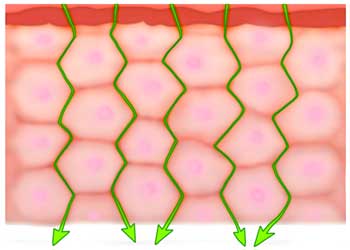
Figure 1: Intercellular lipid pathway
As shown in Figure 1, the stratum corneum consists of cells known as corneocytes. The spaces between the corneocytes are filled with substances such as fats, oils, or waxes known as lipids. Some chemicals can penetrate through these lipid-filled intercellular spaces through diffusion.
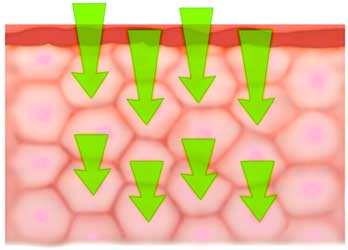
Figure 2: Transcellular permeation
As shown in Figure 2, another pathway for chemicals to be absorbed into and through the skin is transcellular, or cell-to-cell, permeation whereby molecules diffuse directly through the corneocytes.

Figure 3: Through the appendages (hair follicles, glands)
As shown in Figure 3, the third pathway for diffusion of chemicals into and through the skin is skin appendages (i.e., hair follicles and glands). This pathway is usually insignificant because the surface area of the appendages is very small compared to the total skin area. However, very slowly permeating chemicals may employ this pathway during the initial stage of absorption.
Okay, so if synthetic chemicals can work their way into your system through your skin then essential oils should be able to do the same, right?
Absolutely.
In fact, they do it better!
Why?
Because of two things:
1) They are organic and therefore carbon based.
2) They are complex.
Your body is smart. It knows the difference between a synthetic and a carbon. When a pharmacological medication is developed they find a natural substance that creates the desired result then they copy it. Why? Because you can't patent a naturally occurring substance. But because of the complexity of the organic substance they cannot copy it exactly. To put this is easy-to-understand terms: an organic molecule is 3-dimensional. When they make a synthetic copy of it, they essentially take a picture of it; they only capture what is on the surface or first level. The surface of an organic molecule may have 20 or so constituents. However, when you add in the additional layers it can contain HUNDREDS. Therefore, making it impossible to replicate. This is why you get weird side effects with drugs; you are carbon based, essential oils are carbon based, drugs are not. Even though you may get the desired effect from the 'picture' or synthetic form of the organic compound your body knows it is not a natural substance and will attack it. The synthetic is not the complete substance, it is a copy of PART of the working compound. That is why you develop side effects.
That is also why you use ONLY CPTG grade Essential Oils.
From Modern Essentials:
Topical application is the process of placing an essential oil on the skin, hair, mouth teeth, nails or mucous membranes of the body.
Direct Application:
Direct Application is applying the oils directly on the area of concern. Because essential oils are so potent, more is not necessary better. To achieve the desired results, 1-3 drops of oil are usually adequate. A few guidelines for direct application of oils are as follows:
- The feet are the second fastest area of body absorption because of the large pores. Other quick absorbing areas include behind the ears and on the wrists.
- 3-6 drops per foot is usually adequate
-When massaging a large area of the body, always dilute the oils 15%-30% with fractionated coconut oil.
-Use caution when creating blends for topical therapeutic use. The chemical properties of oils can be altered when mixed improperly, resulting in some undesired effects. Layering individual oils is preferred over mixing your own blends. There is no need to wait more than a few seconds between layering as absorption happens very quickly.
Massage:
Massage is the stimulation of muscle, skin and connective tissues using various techniques to help promote healing, balance and connection. Unless you are a certified massage therapist and have a through understanding of anatomy, it is best to use only light to medium massage strokes for applying oils and to avoid the spine and other sensitive areas of the body.
AromaTouch Technique:
do Terra's AromaTouch Technique is a clinical approach to applying essential oils along the meridians and visceral contact points of the back and feet to help balance the sympathetic and parasympathetic nervous systems of the body. Developed by Dr. David K. Hill, a leasing expert in integrative medicine and therapeutic applications of essential oils, the AromaTouch Technique improves well-being by reducing physical and emotional stressors and by supporting healthy autonomic function. The technique is simple and intuitive and uses doTerra's CPTG essential oils for an unparalleled grounding experience for recipients.
Auricular Therapy:
Auricular therapy is a method of applying the oils to various points on the rim of the ears to effect changes on internal body parts.
There are also Compresses which usually involve oil layering and then application of a hot compress to drive the oils deeper faster, and baths which facilitate the absorption of the oils as well as the release of toxins.
The best part of essential oils? Because they are complex, and because your body does not attack them they work together in
SYNERGY
to help the body heal itself: something it was designed to do!
That swollen knee? Yep, that ibuprofen will take down the swelling. However, it will also remain in your liver.
The Food and Drug Administration has ordered that Tylenol, Motrin, and Advil and other popular brands of over-the-counter painkillers and fever-reducers that millions of people take every day for headache and muscle pain must carry stronger warnings about the risks of liver damage and stomach bleeding.
Drugs like Tylenol which contain acetaminophen must now include prominent warnings on their packaging to notify users that too much of the drug can cause severe liver damage.
Or, you can rub some Deep Blue, or Lemongrass or better yet: use both.
It will do the same thing with out killing your liver.
Just to make myself clear:
I am not against occasional use of these drugs!
If you need one, please take one.
If you go to the doctor for strep throat, get an antibiotic.
But if you use a pharmaceutical, use an oil as well.
Use several, some to help the drug and some to counteract the inevitable side effects and allow your body to heal. Don't keep it at war with long term usage.
Or better yet, count your Drops of Wellnes and begin a healthy lifestyle. Reduce your chances of needing a pharmaceudical!
-danielle

Love this. Im a believer :).
ReplyDelete